

2026年 高専入試追試験 英語解説

当ブログでは、授業のポイント解説をしています。
当市には国立高専があり、中3塾生が高専入試に挑戦しました。ここでは、英語の追試験問題について解説します。
2026年 高専入試追試験 英語

1 ア
It rained hard, ( A ) they played outside anyway.
( B ) it rained hard, they played outside anyway.
雨が激しく降っていたが、それでも彼らは外で遊んだ。
A:but B:Although
2 ウ
I ( A ) have any books to read.
I have ( B ) books to read.
読む本は一冊もない(まったくない)
A:don't B:no
3 ア
My school in America ( A ) breakfast every morning before classes start.
We ( B ) breakfast at our school in America every day.
アメリカの学校では毎朝、始業前に朝食が出る。
A:serves B:get
4 ウ
I have a dog ( A ) loves to play with a ball in the park.
My dog ( B ) playing with a ball in the park.
私には公園でボール遊びをするのが好きな犬がいる。
私の犬は公園でボール遊びを楽しんでいる。
A:that B:enjoys
5 ア
I haven't ( A ) the right place to buy the things we need for the party.
I don't know ( B ) to go shopping for the things we need for the party.
パーティーに必要なものを買える場所が見つからない。
パーティーに必要なものをどこで買い物したらよいか分からない。
A:found B:where

1
A : Mr. Yamada, learning as a team is great.
B : That's right. It is helpful for students to be able to talk to each other in every class.
A : I really think ( )
B : Yes, it helps you learn better.
イ we can enjoy our classes more.
私たちは授業をもっと楽しめる
it ~ for 人 to不定詞「...することは人にとって~」
be able to 原形「~することができる」
It is helpful for students to be able to talk to each other in every class.
毎時間お互いに会話できるのは、生徒たちにとって役に立つ。
help 人 + 原形不定詞「人が~するのに役立つ」
it helps you learn better
それはあなたがより良く学習するのに役立つ
※help 人 to不定詞もOK
2
A : Our class has already started, but Tom is not here yet. I think he is sick.
B : Well, I don't think so. He was fine when we were playing video games last night.
A : I see. Then, ( )
B : He is probably still in his bed.
エ where is he now?
彼は今どこにいるの?
have + 過去分詞(完了)「すでに~している」
Our class has already started
存在のbe「~がいる、ある」
Tom is not here yet.
トムはまだここにいない
He is probably still in his bed.
おそらくまだベッドで休んでいる
3
A : Wow, you have borrowed many books from the library again. You really like reading books.
B : Yes, I do. ( ) How about you?
A : Well, I don't go to the library very often.
ウ I get books there twice a week.
週に二度、そこで本を借りるよ。
how about ~?「~はどうですか?」
4
A : Tom, I hope you will come to our town festival next Saturday.
B : Oh! I haven't heard of your festival. Let's go together. I love festivals.
A : Our festival is held in Green Park at night, and it is very beautiful with many lanterns.
B : OK. ( ) I don't know where Green Park is.
ウ But can you take me with you?
連れて行ってもらえますか?
take 人「人を連れていく」
接続詞 that の省略
hope that ~「~だと願う」
I hope you will come to our town festival
私たちの町のお祭りに来てほしいな
be + 過去分詞「~される」(受け身)
Our festival is held in Green Park
祭りは緑公園で開かれるよ
疑問詞+主語・動詞(間接疑問)
I don't know where Green Park is.
緑公園がどこにあるか分からない
5
A : You don't have to drive to school to take me home today.
B : Really? ( ) It takes only ten minutes by car.
A : Thanks, but I want to come home by bus with my friends.
イ It's no problem.
問題ないよ
not have to~「~しなくてもよい」
take 時間「時間がかかる」

1
A : Good morning. Welcome to our shop. Can I help you?
B : Yes, please. I lost my favorite hat, so I want to buy a new one.
A : Well, we have many kinds of hats. What ( ア of イ you ウ this エ think オ do カ black ) one?
B : It looks nice. I like black.
3番目:エ 5番目:ウ
What do you think of this black one?
この黒い帽子はどうでしょうか?
think of ~「~について思う」
形容詞の連続
形容詞"this"+形容詞の場合、thisは修飾する名詞から一番遠いところに置く。
代名詞 one「それ」
I lost my favorite hat, so I want to buy a new one.
✖ I want to buy a new it
one(それ)は、同一のものだが代わりのもの
look + 形容詞「~のように見える」
2
A : I really enjoyed her presentation. In my opinion, it was the best presentation this year.
B : Yes, it really was. I'm looking ( ア results イ forward ウ seeing エ the オ to カ of ) the contest.
A : I think she will win the first prize.
3番目:ウ 5番目:ア
I'm looking forward to seeing the results of the contest.
コンテストの結果を見るのを楽しみにしている
look forward to ~「~を楽しみにする」
look forward to + 名詞or動名詞(ing)
※to不定詞ではない
3
A : Can you tell me how to get to your school? I need to go there this weekend.
B : Sure! Take the bus and get off at the bus stop next to the main gate.
A : Is the gate open on weekends?
B : Yes. It is always open ( ア around イ if ウ is エ it オ end カ the ) of the year.
3番目:ウ 5番目:カ
It is always open if it is around the end of the year.
年末ごろならいつでも開いている
around「~ごろ、およそ~」
→時間や数に関係のある語が続くとき
the end of ~「~の終わり」
how to不定詞「~する方法」
get to 場所「~に着く」
take 乗り物「~に乗る」
get off 乗り物「~を降りる」
next to ~「~の隣にある」
4
A : I'm going to go to America this spring.
B : Oh, that's great. Where will you go?
A : New York. But I ( ア because イ nervous ウ have エ very オ am カ I ) to take a long flight.
B : Don't worry. You can have fun on the flight.
3番目:イ 5番目:カ
But I am very nervous because I have to take a long flight.
フライトが長いのでとても心配
have to 原形「~しなければならない」
be going to 原形「~する予定」
have fun「楽しむ」
5
A : I had a delicious meal at that new restaurant yesterday.
B : Really? I've never been there. What did you eat?
A : Pizza and spaghetti. They had fresh fish and octopus on them.
B : Oh, I like pizza and spaghetti very much. Let ( ア when イ go ウ know エ you オ to カ me ) the restaurant again. I want to join you.
3番目:ア 5番目:イ
Let me know when you go to the restaurant again.
いつまたそのレストランに行くのか教えてください
let me know「知らせてください」
let 人 原形不定詞「(許可して)人に~させる」
疑問詞 + 主語・動詞(間接疑問)
when you go to the restaurant
いつそのレストランに行くのか
have never 過去分詞「一度も~したことがない」
第1パラグラフ
Each year, many people from various areas in Japan and around the world visit Japan's most famous tourist sites. This has some good points, but there are also some problems.
each + 単数
所有格(Japan's)+ 最上級→"the"つかない
所有格(my,yourなど)で対象が特定されている。"the"は「定冠詞」といい、特定のものを指す語。
指示語this→前の文を指す
there be ~「~がある、いる」
第2パラグラフ
One good thing is that visitors ( 1 ) money to these towns and cities. They payア for hotels, food, and gifts. For example, in cities like Tokyo and Kyoto, tourists often enjoy many types of food and buy souvenirs for their friends. This helps local shops and restaurants.
(1)エ bring「~をもたらす」
be that~「~ということである」
第3パラグラフ
Another good point is that people visiting historic cities can learn about Japanese history and traditionsイ, like castles, the tea ceremony, and summer festivals. They can understand Japanese culture better and make many wonderful memories.
現在分詞(~ing)の後置修飾
people visiting historic cities
歴史のある町を訪れる人々
第4パラグラフ
At the ( 2 ) time, people from different places can meet each other. This is helpful not only for Japanese people ( 3 ) also for visitors from other countries because they can understand each other better and become friends.
(2)イ same
at the same time「同時に」
(3)ア but
not only A but also B「AだけでなくBも」
第5パラグラフ
However, there are also some problems. One problem is that some places become too crowdedウ. Many people visit popular tourist sites, ( 4 ) some famous temples and shrines in Kyoto. When there are too many people, it is sometimes hard to walk around.
(4)ウ such as
such as ~「~のような」(例示)
it ... to不定詞「~するのは...である」
it is sometimes hard to walk around
時として散策するのが困難になる
第6パラグラフ
Another problem is that some tourists get too excited. For example, people are usually ( 5 ) in hotels and on buses and trains. However, some tourists talkエ very loudly, and this may be a problem for other people.
(5)エ quiet「静かな」
get + 形容詞「~になる」
第7パラグラフ
In addition, some visitors throw away emptyオ bottles and other types of litter in the wrong places. This makes streets and parks dirty and damages the environment. Also, the local people have to clean up this garbage.
in addition「加えて」
throw away~「~を捨てる」
this + 三単現s→代名詞thisは単数
make A B(SVOC 第5文型)
「AをBの状態にする」
have to 原形「~しなければならない」
第8パラグラフ
Many foreign visitors and Japanese people travel to popular areas for ( 6 ). So we should try to find more effectiveカ ways to help these tourists enjoy their vacations and also protect local areas.
(6)エ sightseeing「観光」
try to不定詞「~しようとする」
way to不定詞「~する方法」
help 人 原形不定詞「人が~するのに役立つ」
問2
1)オ empty「空の」
having nothing inside
中身が何もないこと
2)エ talk「会話する」
to communicate by saying things
話してコミュニケーションをとること


問1
Takeshi's school has 500 students, and all of them took part in the research.
学校の生徒数は500人、調査に全員参加した。
However, it was chosen by only 75 students.
スポーツ活動はわずか75人
👉75÷500×100=15%
Using the Internet was selected by the most students, and Studying was the second most popular option.
最多はインターネット利用、2番目に多い選択肢が勉強
Only 40 students chose Going shopping.
買い物はわずか40人
👉40÷500×100=8%
A:Studying B:Playing sports C:Going shopping
答え ア
問2
The number of students who chose To use social media is half of the number of students who chose To search for information.
ソーシャルメディアの利用は、情報の検索の半数
👉90%÷2=45%
The highest percentage of the students answered To search for information.
情報の検索の割合は最多
To watch movies was selected by 70 percent of the students. This equals 140 students.
映画鑑賞の割合は70%、実数は140人。
👉調査対象 140÷0.7=200人
The lowest percentage of the students who chose Using the Internet selected To read news. This equals ( E ) students.
インターネットの利用を選んだ生徒のうち、ニュースを読む割合は最小。実数は(E)人。
👉200×0.2=40人
答え 1)イ 2) エ
第1パラグラフ
Takeshi is a junior high school student. As part of a school project, he researched how students spend their weekends. Takeshi's school has 500 students, and all of them took part in the research.
疑問詞 + 主語・動詞(間接疑問)
he researched how students spend their weekends
生徒たちがどのように週末を過ごしているかを調査した
take part in~「~に参加する」
第2パラグラフ
First, Takeshi asked all of the students, "How do you usually spend your weekends?" Students could select only one answer from five options: Using the Internet, Playing sports, Going shopping, Reading books, or Studying. The results are shown in Table 1. Takeshi thought that Playing sports would be the most popular activity because he likes sports. However, it was chosen by only 75 students. Using the Internet was selected by the most students, and Studying was the second most popular option. Only 40 students chose Going shopping.
be + 過去分詞「~される」(受け身)
The results are shown in Table 1.
その結果が表1で示されている
※show - showed - shown
it was chosen by only 75 students
わずか75人の生徒が選んだ
Using the Internet was selected by the most students
インターネットの利用が最も選ばれた
動名詞(ing)の主語
過去助動詞would→時制を一致させる
Takeshi thought that Playing sports would be the most popular activity
タケシはスポーツをすることが最も人気の活動になるだろうと考えた
the second + 最上級「2番目に~」
Studying was the second most popular option
勉強は2番目に人気の選択肢だった
第3パラグラフ
Next, Takeshi became interested in their reasons for using the Internet. He asked the students who chose Using the Internet, "Why do you use the Internet?" They could choose one or more reasons. The results are shown in Graph 1. The number of students who chose To use social media is half of the number of students who chose To search for information. The highest percentage of the students answered To search for information. To watch movies was selected by 70 percent of the students. This equals 140 students. The lowest percentage of the students who chose Using the Internet selected To read news. This equals ( E ) students.
関係代名詞 who(主格)
He asked the students who chose Using the Internet
インターネットの利用を選んだ生徒に質問した
The number of students who chose To use social media is half of the number of students who chose To search for information.
ソーシャルメディアの利用を選んだ生徒数は、情報の検索を選んだ生徒数の半数である。
The lowest percentage of the students who chose Using the Internet selected To read news.
インターネットの利用を選んだ生徒のうち、ニュースを読むことを選んだ生徒の割合が最も低かった。
A equal B「AがBに等しくなる」
第4パラグラフ
These results show that many junior high school students use the Internet on their weekends, mainly to search for information or watch movies. While physical activities like playing sports are still enjoyed by some, online activities are more popular.
接続詞 while「~の一方で」
While physical activities like playing sports are still enjoyed by some, online activities are more popular.
スポーツなどの身体活動を楽しむ人もいる一方で、オンライン活動の方がより人気が高い。

Takeshi : Mr. Tanaka, I discovered something interesting when I was preparing for this Friday's presentation.
something + 形容詞
I discovered something interesting
何か興味深いことを発見した
→ somethingは形容詞を後ろに置く
Mr. Tanaka : Oh, really? What did you find?
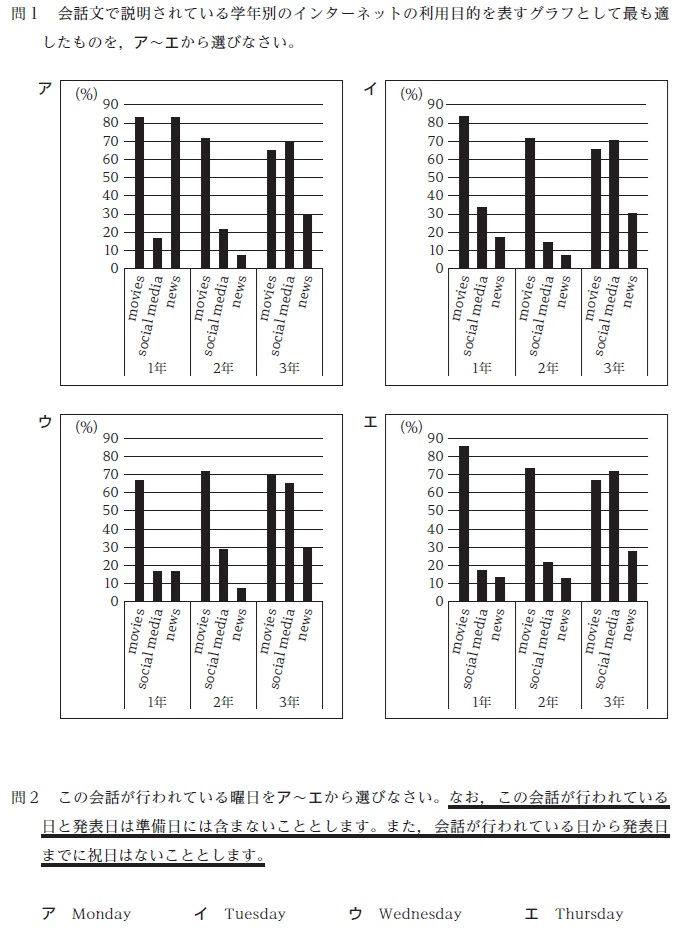
Takeshi : In my research for the school project, I found that three of the reasons for Using the Internet were very different depending on the school year. These three reasons were: To watch movies, To use social media, and To read news.
depending on「~に応じて」
school year「学年」
Mr. Tanaka : I see. Could you tell me more?
Takeshi : Sure. First-year students mostly used the Internet to watch movies. The percentage was very high. But fewer first-year students used it for social media or to read the news.
Mr. Tanaka : How about second-year students?
how about ~?「~はどうですか?」
Takeshi : The percentage for watching movies was still high, and that for reading the news was still low. But the percentage for using social media was a little higher than that of the first-year students.
指示語 that
→ the percentage for using social media を指す
Mr. Tanaka : Interesting. Can I guess the results for the third-year students? I think the percentages for social media and news are higher.
Takeshi : You are right! The percentage for social media was the highest of all of the three reasons in the third year. But how did you know that?
指示語 that
→ The percentage for social media was the highest of all of the three reasons in the third year. を指す
Mr. Tanaka : Well, they always talk about social media. Also, some students start watching the news more often to study for their entrance exams.
Takeshi : I see. I will add this to my presentation.
Mr. Tanaka : That's a good idea. You still have two days before your presentation on Friday. You are doing a good job!
Takeshi : Thanks.
問1
First-year students mostly used the Internet to watch movies. The percentage was very high. But fewer first-year students used it for social media or to read the news.
1年生の大部分は映画鑑賞のためにインターネットを利用した。その割合はとても高い。しかし、ソーシャルメディアまたはニュースの閲覧のために利用する1年生は少数だった。
👉選択肢は、イorウorエ
How about second-year students?
2年生はどうですか?
The percentage for watching movies was still high, and that for reading the news was still low. But the percentage for using social media was a little higher than that of the first-year students.
映画鑑賞の割合は高く、ニュースの閲覧の割合は低い。しかし、ソーシャルメディアの利用の割合は1年生より少し高かった。
👉選択肢は、ウorエ
The percentage for social media was the highest of all of the three reasons in the third year.
3年生では、ソーシャルメディアの割合は3つの理由の中で最も高かった。
答え エ
問2
You still have two days before your presentation on Friday.
金曜日の発表前に、まだ2日あるね。
👉会話している日と発表日は含まないから火曜日
答え イ Tuesday


1. 高専教員
More than sixty years have passed since the first kosen was founded in Japan, and some countries have made similar kosens. The two kosens in Thailand use almost the same educational system as Japan, and every year many students from Thailand come here to study ( あ ) our students in Japan. Japanese students and international students take the same classes, so they [ A ] talk together and learn more about the cultures of their countries. This is one of the ( ① ) things about this program.
接続詞 since+主語・動詞
since the first kosen was founded in Japan
日本で初めての高専が設立されてから
same A as B「Bと同じA」
The two kosens in Thailand use almost the same educational system as Japan
タイにある2校は日本とほぼ同じ教育制度を採用している
every year many students from Thailand come here to study ( あ ) our students in Japan.
毎年、多くのタイ人学生が日本に留学し、本学の学生として学んでいます。
(あ) as
Japanese students and international students take the same classes, so they [ A ] talk together and learn more about the cultures of their countries.
日本の学生と留学生は同じ授業を受けるので、彼らは一緒に話ができ、互いの国の文化をたくさん学ぶことができる。
(A) are able to
This is one of the ( ① ) things about this program.
これがこのプログラムに関する最も良い点のひとつ
(①) best
2. 中学校教員
I teach ( い ) a junior high school, and every year some students try to enter the nearest kosen. There [ B ] allows a student to take the entrance exam at the nearest test center to enter a kosen in another prefecture. For example, they can take the exam in Okinawa to enter a kosen in Hokkaido. This is very ( ② ) because one of my students wants to study architecture but her nearest kosen doesn't teach it. She is very happy that she can take the exam for a kosen in a different prefecture.
I teach ( い ) a junior high school
私は中学校で教えている
(い) at
There [ B ] allows a student to take the entrance exam at the nearest test center to enter a kosen in another prefecture.
他県の高専に入学するために、最寄りの試験会場で入学試験を受けることができる独自の制度がある。
(B) is a unique system that
This is very ( ② ) because one of my students wants to study architecture but her nearest kosen doesn't teach it.
この制度はとても役に立っている。理由は、私の学生の一人が建築を勉強したかったが、最寄りの高専でそれを教えていなかったから。
(②) helpful
3. 高専生(健太)
I am a member ( う ) the basketball team at my kosen, and I'm really happy because we can play together and support each other. I have a lot of good friends on the team, and they are very ( ③ ) and always help me study. I am not very good at English, but I want to work abroad in the future. So my friends teach me English grammar before my exams. I still [ C ] one or two subjects, but for me, every day is great.
I am a member ( う ) the basketball team at my kosen
私は自分が通う高専のバスケットボール部員
(う)of
they are very ( ③ ) and always help me study
友達はとても親切で、いつも私の勉強を手伝ってくれる。
(③)kind
help 人 原形不定詞「人が~するのを手伝う」
they are very kind and always help me study
teach A B(SVOO 第4文型)
my friends teach me English grammar
友達は私に英語の文法を教えてくれる
I still [ C ] one or two subjects
(C)have some trouble with
一つまたは二つの科目にまだ課題がある
4. 高専生(啓子)
When I was a child, I didn't enjoy being ( え ) others, but I was very interested in machines and computers. At my kosen, I often work in a team to do experiments in our laboratory. At first, [ D ], but because all the students help each other, I now enjoy working with other people. I know that engineers usually work in teams, so they often experience this kind of satisfaction. Working in teams may be ( ④ ) , but it's important.
When I was a child, I didn't enjoy being ( え ) others
子どものときは、他の人と一緒にいるのが好きではなかった。
(え)with
At first, [ D ], but because all the students help each other I now enjoy working with other people.
最初は少し怖かったけれど、生徒同士が助け合うので、今では他の人と一緒に作業するのが楽しい。
(D)it was a little scary
Working in teams may be ( ④ ) , but it's important.
チームで作業するのは難しいことかもしれないが、それは大事なこと。
問1 ア
問2 イ
問3 ウ
問4(1)ア (2)ウ
I am teaching a girl who really enjoys math and science. She wants to build beautiful houses in the future, and it is very interesting to hear her plans. I said that she is excited to know that there is a way to go to a kosen far from her home. ( )
私は数学と理科が大好きな女子生徒を教えています。彼女は将来、美しい家を建てたいと思っていて、その計画を聞くのはとても興味深いです。私は彼女に、自宅から遠く離れた高専に行く方法があることを知って、とても喜んでいると伝えました。( )。
ア I hope she can study the subjects that she likes.
彼女が好きな科目を勉強できることを願っています。
イ Some of the people in my family like to read books at home.
私の家族の中には、家で本を読むのが好きな人が何人かいます。
ウ Now he has to speak English every day.
彼は今、毎日英語を話さなければならない。
関係代名詞 who(主格)
I am teaching a girl who really enjoys math and science.
it ~ to不定詞(形式主語 it)
「...することは~である」
it is very interesting to hear her plans.
be excited to不定詞「~して興奮する」
接続詞 that「~だと」
I said that she is excited to know that there is a way to go to a kosen far from her home.
問5(1)ウ (2)イ
You have many good friends at your kosen. That's great! It was difficult for me to talk to other students when I was in elementary school. However, ( ). I enjoy studying at my kosen, too.
あなたの高専にはたくさんの良い友達がいるんですね。素晴らしい!私は小学生の頃、他の生徒と話すのが苦手でした。でも、( )。私も高専で勉強するのが好きです。
ア when I want to talk with a worker in your company
あなたの会社の従業員と話したいとき
イ if I never go abroad with my family
もし私が家族と海外旅行に行かなかったら
ウ because my classmates and teachers are friendly
クラスメートや先生たちが親しい間柄だから
it ~ for 人 to不定詞(形式主語 it)
「...することは人にとって~である」
It was difficult for me to talk to other students
👉2026年 高専入試 数学(本試験)
【 たむかい学習教室 】
教員経験20年 プロ講師による
完全マンツーマン指導
追加料金なし 安心の授業料で
手厚いサポート

塾生のホンネ
「数学や英語が苦手。何から始めたらいい?」
「長い問題文が苦手。どうしたらいい?」
「学校の授業で難しいことが増えてきた」
「受験が不安。テスト成績を上げていきたい」

完全1対1授業でホンネを解決!
★苦手の克服に最適★
★受験に強い個別指導★
★経験豊富な講師の一貫指導★
★安心の授業料で全力サポート★

★苦手の克服に最適★
5教科対応、完全マンツーマンで指導いたします。弱点を着実に克服でき、「わかる・できる」につながります。学校の授業が定着しやくすなり、成績アップも期待できます。
★受験に強い個別指導★
入試の出題範囲は広く、十分な対策時間と学習量が必要になります。受験に向けて、対策時間と学習量をしっかりと確保できるのは、完全1対1授業の強みです。
★経験豊富な講師の一貫指導★
教員経験20年の講師が確かなノウハウで、難解な内容もわかりやすく丁寧に指導いたします。初めての受講生からも「分かりやすい」「納得の解説」と好評です。
★安心の授業料で全力サポート★
入塾費や高額な教材費、授業料以外にいただく追加料金は一切ございません。安心の授業料で全力サポートいたします。
<1か月授業料(税込)>
90分授業:14,800円(月4回)
120分授業:17,600円(月4回)
(例)1回・90分授業の場合
教師1名・生徒3名の複数指導
→1名につき30分の個別指導
指導時間3分の1、実質料金は割高に。
↕
教師1名・生徒1名の完全個別指導
⇒完全90分の個別指導(当塾)
生徒1名に100%の指導時間
親御さんの声
「できる問題が増え勉強に自信がついたようで、期待感があります」
「苦手だった英語と数学が伸び始めたので、正直ホッとしています」
「成績の伸び幅と年間の費用を考えると、転塾して正解でした」
合格実績
八戸高 八戸東高 八戸北高 八戸西高 国立八戸高専 八戸工業高 八戸商業高 八戸工業大学第一高 八戸工業大学第二高 千葉学園高 八戸聖ウルスラ学院・英語科
八戸聖ウルスラ学院中学 八戸工大二高附属中学
指導実績
八戸市立第一中 第二中 第三中 長者中 根城中 白山台中 小中野中 白銀中 鮫中 大館中 東中 下長中 北稜中 是川中 南浜中 明治中 中沢中 八戸工大二高附属中 階上町立階上中 南部町立福地中 岩手県洋野町立大野中 久慈市立久慈中
八戸東高 八戸北高 八戸西高 八戸聖ウルスラ学院高 仙台育英学園高ILC
吹上小 中居林小 柏崎小 長者小 根城小 新井田小 旭ヶ丘小 西園小 南郷小 角の浜小
今年度塾生35名(2026年2月現在)
「体験学習」を実施しています
通塾をご検討の方に無料体験学習を実施しております。
当日の学習科目は希望制です。小学生から中高生まで、ご要望にお応えできるよう授業を進めさせていただきます。

ご入塾までの流れ
体験学習(60分)
入塾をご希望の場合、
保護者面談の日程調整
↓
保護者面談(40分程度)
お子様の受講に関わるご説明
保護者の方からのご相談・ご要望
↓
受講開始手続き
体験学習・実施日時はこちら
塾生の声
苦手意識から「自信」へ
(中学3年)

今まで分からないことが多く、学校の授業についていけないことがあったり、テストで全く解けない問題もありましたが、先生から考え方や解き方を分かりやすく丁寧に教えてもらい、解ける問題が増えてテストの点数が大きく上がりました。この教室に通って、勉強に自信が持てるようになりました。
3年間の積み重ねで受験合格
(小学6年)

4年生の時から通い始めました。3年間の授業で、先生は分からない問題を理解しやすく、そしてやさしく教えてくれました。本当にこの塾で良かったと思っています。6年生の冬には、志望校の受験に合格することができました。一貫校に進むので、次は大学受験です。中学に上がっても、目標のためにこの塾で学んでいきます。
苦手の克服が高得点に
(高校1年)

苦手の英語を克服するために通い始めました。長文対策では、先生と一緒に音読練習や和訳などに繰り返し取り組み、テストでは高得点を取れるようになりました。通う前より、勉強の量だけでなく、勉強の質も上げることができました。他教科の苦手にも向き合って、「得意」に変えていけるよう、この教室で学習を続けていきたいです。
受講に関するお問い合わせ
ご相談はお気軽にお尋ねください

電話番号
050-3637-1500
電話受付 10:00-21:00
体験学習のお申し込みはこちら
住所
イオン田向店から車で1分
【周辺道路 車での所要時間】
八戸大野線
三陸道是川IC2分
パークホテル5分
八戸環状線
八戸道八戸IC8分
四本松交差点8分
10分圏内の地区
八戸市田向 吹上 南類家
中居林 石手洗 十日市
柏崎 青葉 類家 諏訪
長者 糠塚 沢里 根城
旭ヶ丘 新井田 妙
白山台 是川

2026.3.21 2026年 高専入試追試験 英語解説